Dated 27th January, 2026
A year-long initiative to strengthen land rights among tribal women in West Bengal has made notable progress in improving awareness, confidence, and access to land administration systems across four districts—Bankura, Purulia, Jhargram, and Paschim Medinipur.
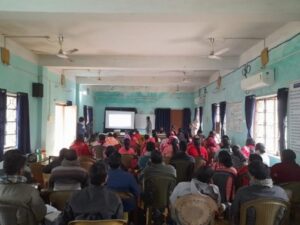 The project, “Empowerment of Tribal Women by Strengthening their Land Rights,” has been very successfully
 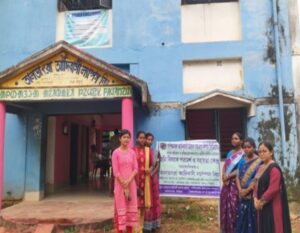 implemented by SIGMA Foundation with support from Landesa, a USA based organization working on land rights across the globe, during January to December 2025. It provided training on land literacy to tribal women to address the long-standing barriers like poor knowledge on land rights and land records, male members of the family not allowing them to participate in land related discussions and on customary inheritance practices, which they face.
Through the Women’s Land Literacy (WLL) programme, 10,007 tribal women from 1,290 SHGs across 63 LAMPS (Large Area Multipurpose Society), have been trained against a target of training 10,000 such women. To raise awareness of the tribal society on women’s land rights, 20,000 bilingual land literacy leaflets (Bengali and Santhali) were distributed via SHGs and LAMPS. Capacity-building efforts included training of 200 District Level Trainers and 150 LAMPS Level Trainers, while 650 SHG-based sessions reached to build capacity of the trainers who took day long training sessions following a specially designed curriculum approved by the Tribal Development Department, Government of West Bengal. The trainings were also supported by the department and the Regional Managers, WBTDCC of the respective district were actively involved in organizing the training.
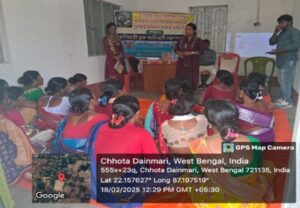
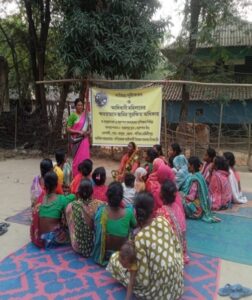 Institutional engagement was strengthened through convergence meetings with BL&LROs and Panchayat representatives and the establishment of a Land Facilitation Centre at Taldangra Adivasi LAMPS Ltd., that helps providing land recordation related services to the people. A web-based MIS and mobile application enabled systematic monitoring of 7,033 participants, complemented by a rapid outcome study involving 278 women.
Findings of the study indicate positive outcomes: as over 90% of participants reported improved understanding of land documentation, and 50.7% verified their land record status online after the training. Women also showed increased confidence in discussing land issues within families and SHGs, with several initiating land record correction and mutation processes. Despite challenges such as administrative delays and continued reliance on intermediaries, the initiative has laid a strong foundation. The next phase will focus on refresher trainings, hands-on digital practice, structured engagement with land officials, and convergence with livelihood programmes to ensure lasting socio-economic benefits for tribal women.