
Hamburg, Germany | 29 June 2026
SIGMA Foundation presented its innovative model for domestic greywater recycling at the 15th Hanseatic India Colloquium, held in Hamburg, Germany, on 29 June 2026. The conference, themed “Indo-German Dialogue: Circular Wastewater Management for Sustainable Development,” brought together researchers, practitioners, and policymakers from India and Germany to exchange knowledge and experiences on sustainable water management. 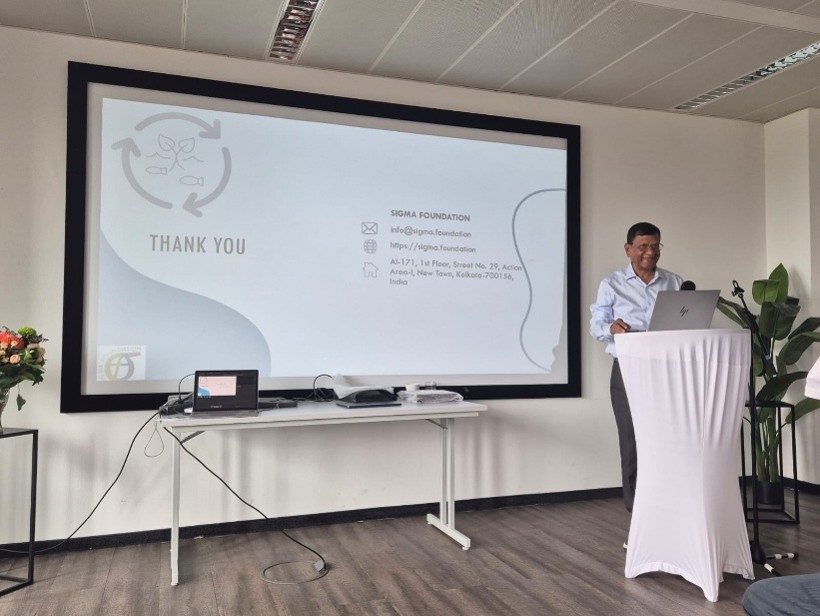
Dr. M. N. Roy, President of SIGMA Foundation, was invited by the organizers to present the Foundation’s pioneering work on decentralized greywater recycling for sustainable agriculture.
During his presentation, Dr. Roy highlighted a demonstration project implemented in Jangipara Gram Panchayat with support from Sign of Hope, Germany. The system uses a simple filtration arrangement using sand, gravel and charcoal to treat domestic greywater, making it suitable for irrigation. Laboratory analysis showed that the coliform level in the treated water was reduced from 3,300 MPN/100 ml to 49 MPN/100 ml, which is well below the acceptable limit of 1,000 MPN/100 ml for irrigation.
The treatment unit recycles approximately 250 kilolitres of greywater annually, providing year-round irrigation to a 5-kattha (0.165-acre) agricultural plot. This has enabled the cultivation of leafy vegetables and other crops throughout the year, generating an annual income of around ₹80,000 for the participating household.
An additional benefit of the system is its ability to retain a portion of the nutrients present in domestic greywater, including phosphates and nitrates. These recycled nutrients have contributed to an estimated 50% increase in the yield of leafy vegetables, such as spinach and water spinach. Since the treated water flows to the field entirely by gravity, the system requires no external energy for pumping or water transport, making it both environmentally sustainable and cost-effective.
The project demonstrates how a simple, low-cost technology can strengthen climate resilience in agriculture by providing a reliable source of irrigation without extracting groundwater. At the same time, it enhances crop productivity through nutrient recycling and supports circular resource management.